I resent having been brought into existence without my consent
(and other funny memes)

For years, my Instagram bio read “antinatalist”.
Instagram bios are tombstones for the living: there isn’t much room, so you carve it down to the bare essentials. For me, antinatalist fit the bill. It’s at the core of who I am (along with “political vegan,” “mountain runner,” and “prison abolitionist,” if I remember correctly.)
These days, I leave antinatalist out of my bio not because I changed my mind, but because that word deserves more context and conversation that 150 characters could possibly allow.
No one asks for this
I just spent a week with my parents; the best week we’ve probably had in 25 years (I’m 35). But the feelings that have underlined my relationship with them, and with parenthood in general, never budge. When I was a kid, I didn’t have the vocabulary, but I had the thought: this is a lot to carry. Also: I didn’t ask for any of this. (Having talked to many therapists between now and then, I realise that it’s not a common thing for a kid to think.)
As I grew older, I learned to articulate it: we are all brought into existence without our consent. Then, at some point, the moral and practical responsibility for that life shifts onto us. Ready or not, willing or not. To me, that feels like a twisted kind of game. To be held accountable for something you never asked - or agreed! - to participate in.
Because I find it so perplexing that some people seem to view life as a gift, I did what any serious philosophers would and made an Instagram poll:
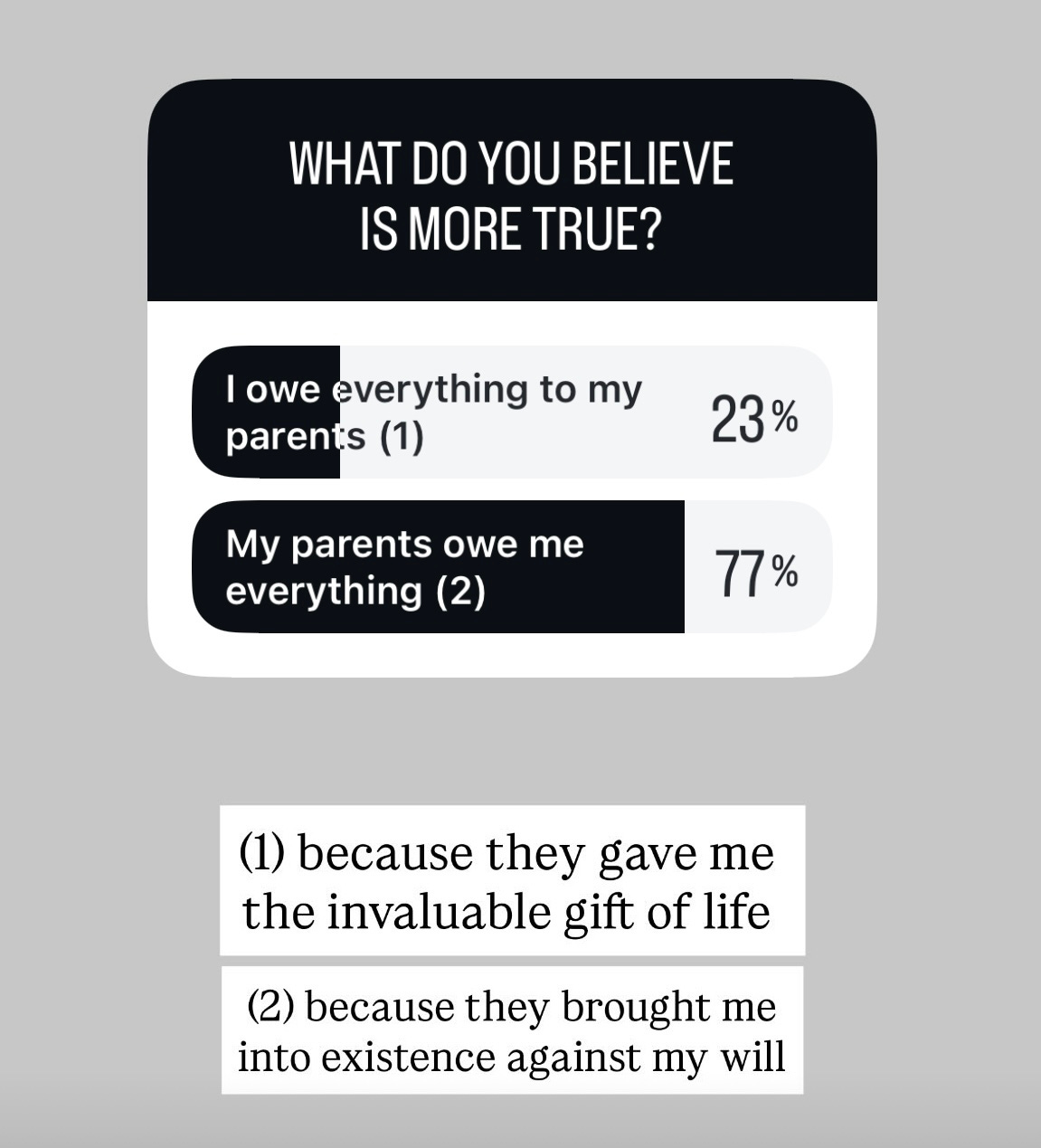
Existence as a gift
I’ve lived with depression, anxiety, and eating disorders for most of my life; an experience that makes me painfully unexceptional in modern society. The root of my depression, to overly simplify it to the max, is being a highly sensitive person forced to exist in a world that more often than not is unbearably violent (towards me a little bit; towards most beings, human and nonhuman, a lot more).
To me, it feels like a logical conclusion to feel resentment towards the people who brought me into existence. And the times I was deep in the kind of depression where suicide starts to look like the only possible relief, I faced another dilemma: I couldn’t put my parents through that kind of pain. (I’m an only child. My parents, especially my dad, struggle with their own mental health issues; not that it would be easy for any parent in any context to lose a child to suicide, but I found my situation even more pressuring because of that).
So for me, it’s felt like a full-circle emotional blackmail: I was brought into existence against my will by two people’s self-serving choice, and now I’m expected to stay alive for their sake.
(This is something I’ve actually talked about with my parents. It was hard, obviously, but I consider it their responsibility to sit with the consequences of their actions. I told them how I felt: that I never consented to being here, that their decision was selfish. To their credit, they listened. And I think it’s freeing for all of us that this is now out in the open; and that they could admit it was purely selfish from them, and to say they’re sorry.)
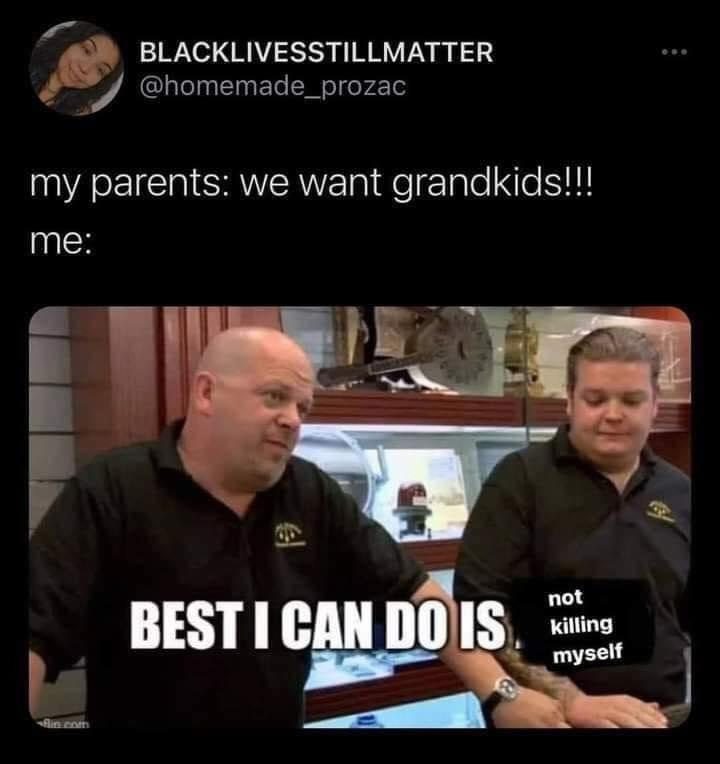
But as much as I think that the sentence “life is a gift” is Stockholm syndrome, if you’re reading this and genuinely believe that life is a gift, I would love for you to leave a comment and explain what it means for you. (One of my friends who is religious said she sees life as a gift from God, and not her parents; which I think is a very interesting thought)
What do we mean when we say we “love” our parents?
I love my parents; I genuinely believe I like them as people. I see their flaws and their trauma, and I don’t think they should’ve had a kid; but I love them for who they are regardless. And I love other parents too, I have friends who are parents (I’m aware this sounds like the antinatalist equivalent to “I have a Black friend”).
But how can I be sure I don’t think I love them because it’s my biological makeup? Unless we’re bell hooks, we don’t spend much time pondering about love or trying to define it; we don’t take it too seriously. So can we know we love someone, let alone the people we’re biologically wired to feel attached to?
If we were to describe the relationship we have with our parents, I would bet that for a lot of us, it would sound like a toxic relationship. They love a version of you they wish existed but doesn’t? You love a version of them you wish existed but doesn’t? Seeing them feels like a chore? You get triggered by what they do, what they say, how they say it? You have to refrain from saying what you really want to say because you fear the consequences?
The sick game of consciousness
I am not depressed anymore. I’m very content with my life for the most part. But I still think existence feels like a sick game. We’re the only species cursed with a brain big enough to reflect on our own death, and on the death of everyone we love. If that isn’t a twisted form of psychological torture, I don’t know what is.
In addition to that, being alive comes with an endless list of obligations (obligations that in a lot of ways get worse as we age). Here’s a non-exhaustive list of things I resent being forced to do: keeping my body healthy, keeping my mind stable, working most of my waking hours to afford a life I didn’t ask for, building and maintaining relationships so I don’t collapse into loneliness, finding a place to live, managing said place to live, paying bills to companies I hate, making decisions that could ruin or save the rest of my life, and constantly keeping at bay the knowledge that everyone I love will die.
If we all agree that suffering is inevitable, and even the most optimistic among us admit that (worth noting that this isn’t a new thought: buddhists have believed life is suffering for millennia), then why keep subjecting new people to it? Isn’t the ultimate form of freedom, compassion - and maybe, controversially, of intelligence - deciding to opt out?
Gabor Maté said it better
Even if you’re the most loving, intentional, self-aware parent in the world (which, just to be clear, I think is impossible) you still can’t protect your child from harm. You can’t control what happens at school, how their peers treat them, or what random cruelty the world decides to throw their way. You can’t stop heartbreak, humiliation, illness, or loss. You can’t shield them from the weight of existence itself.
Gabor Maté talks about how childhood trauma isn’t limited to the obvious horrors of abuse, neglect, and violence. It’s also the everyday moments of disconnection and overwhelm that a child’s nervous system can’t make sense of. And we all carry some version of that. Even children raised in love spend their adult lives trying to heal from the pain of simply being alive, from unmet needs, from tiny ruptures that add up, from the impossible task of being human.
How can you possibly protect someone from the suffering inherent to existence under capitalism? Under a patriarchal, white supremacist, classist system? How do you protect someone from unavoidable emotional and sexual abuse? How can you see the world we live in a decide it’s an acceptable place to bring a vulnerable being into?
Everyone you know suffers from some form of mental illness but you think that, magically, your kids will be fine? That’s not optimism babes, that’s delusion.
I like using my own example because I’m not someone who had a particularly difficult or traumatic life and still, the suffering far outweighs the pleasure and the joy. I had a pretty unremarkable life: I had an okay childhood with loving parents who did their best. Like most kids, I was bullied, mocked and ridiculed for not fitting in, in different ways at different ages. I was a girl and am now a woman so naturally I was sexually abused in countless ways. Because of the toxic system we live under, I developed self-destructive coping mechanisms from an early age. I navigated a very complicated and violent world the best way I could. As I grew older and matured, I realised I had to make the conscious choice of staying alive, and that I alone had to carry the responsibility of my own existence. As a matter of fact, I’ve become so invested in trying to stay alive, that I have recently created this list as a compass for myself and others.
So when I think about antinatalism, I don’t see it as pessimism. I see it as the acknowledgment that even under the best circumstances, life guarantees some degree of trauma. To bring someone into the world is to sentence them to a lifetime of patching themselves back together, a process most of us will die not having completed.
“I have so much love to give”
Here’s one of the usual counterarguments: reproduction is natural, we’re biologically wired for it. But guess what? So are rape, murder, and infanticide. Humans have historically defined morality against natural urges. So as a species who has made it our number one source of pride to differentiate ourselves from other animals, I find it bizarre how attached we are to such a basic instinct, going as far as calling it “meaning”, “calling” or “purpose”.
Have you ever asked someone why they had kids or why they want kids? They can never give you one reason that isn’t deeply self-centred. “I want to see what they’d look like” or “I really want to be a parent”. My personal favourite is “I have so much love to give”, where we go as far as weaponising “love” to justify selfishness. If we really took consent seriously, we’d have to admit that we’re willing to ignore it as long as it serves our own vanity.
If you’re a parent reading this, first, thank you. I know it must be hard. Second, I think you should, truly, deeply understand that you carry an immense responsibility towards your children, and spend the rest of your life acting accordingly. (But if you’re lucky, your kids aren’t ungrateful little brats like me!)
True environmentalism means stop breeding
I’ll be transparent here, the environment is not one of the reasons I refuse to procreate; but I would like to briefly talk about most people’s presumed concern for the environment.
I see so many people being up in arms about the destruction of the planet, and it leaves me wondering what they don’t understand. Do they not understand the planet is going to shit 100% because of humans? Isn’t the logical conclusion to that problem to stop making new humans?
I am very cynical about the environmental movement for this very reason: you don’t actually care about the planet, you care about the future of your species on the planet. And these are two different concerns (they’re actually opposite concerns!).
The case against being born
Someone commented on my recent instagram post (where I teased this article like the good millennial I am), and talked about David Benatar’s work. I haven’t read his book (I didn’t even know he existed), but I found a couple articles online. He articulates what I’d always felt: that there’s an asymmetry between pleasure and pain. The absence of pain is good even if no one experiences it; the absence of pleasure isn’t bad unless someone exists to miss it. In other words: if someone is never born, they’re spared all suffering without being deprived of anything.
I studied a little bit of philosophy, so I know that philosophers have long talked about consciousness as a tragic flaw, or a torturous device. And when you live with depression even a little bit, it’s easy to understand what they mean. Even when life feels “good,” it’s built on constant maintenance. Pleasure is fleeting. Pain, in one form or another, never really leaves.
So when people hit me with the usual “But what about love, joy, sex, purpose?” I don’t deny those exist. They’re real, I feel them; sometimes I feel the sun on my face in the mountains, or I nestle my head in my lover’s neck, and think “it’s good to be alive”. But for me, these feelings don’t cancel out the inherent and intangible injustice of being thrust into existence without choice. Love and pleasure can make life bearable; they don’t make life justified.
One last midnight
Antinatalism isn’t about hating life or wishing for death. It’s about recognising that creating life is an ethical decision with enormous consequences. I don’t think existing people should die (unless they want to). I think we should stop forcing new people to carry the burden of existence.
I’ve decided to live (mostly cause I don’t feel like I have a choice), so I justify my existence by trying to do good, by fighting for justice. That’s one of my coping mechanisms: finding existence so unfair and difficult makes me want to do my part to bring about as much justice and soothing as I possibly can to others.
I know most people strongly disagree with me; I’m fine with that. I would just like for more of us to consider antinatalism maybe being the ultimate form of radical compassion, and selfless love.
***
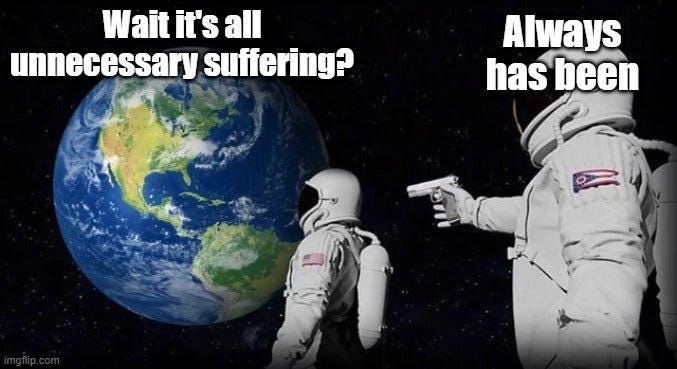
I have one last midnight tattooed on my right collarbone. It comes from the series True Detective, in which Rust says: “I think the honorable thing for our species to do is deny our programming. Stop reproducing. Walk hand in hand into extinction, one last midnight.”
You write so well, I loved reading this as you articulate many of my own thoughts and feelings. My neck is always there for your head to nestle into ❤️
It doesn’t matter whether I agree or not with what you say (this time I do), it always spins around in my head for a few days after I read you. You’re an incredibly talented writer and I’m glad you’re alive.