We're All Kanye's Bully
on Kanye West, cancel culture, and the shared responsibility of it all

Note: All quotes in this articles are from To Those I’ve Hurt, Kanye’s apology letter published in January 2026 in the New York Times
For years, I’ve been trying to write an article about Kanye West.
I’ve written pages and pages, I’ve made road maps that I stuck on my living room walls, I’ve obsessed over what the right thing to say is, and how to say it perfectly. But I don’t think anyone can write a perfect article about a person this complicated, and a story this public, layered, ugly, and unfinished.
I’ve stayed quiet this long because there is too much to say, but also because what I want to say is not neat, and a lot of people no longer seem very interested in anything that cannot be flattened into a clean moral position that makes them feel good about themselves.
For those who don’t know yet: I’m a huge Kanye fan, and I do not mean that in the light, casual, enjoyed My Beautiful Dark Twisted Fantasy kind of way. To give you an idea: my fandom peaked when I ended up in the 0.001% of Kanye listeners in 2023, which I think tells you less about my music taste and more about my general psychological profile.
And for those who don’t know that either: Kanye just released a new album. And with it, the usual dance began again, praise from the fans who remain, condemnation from everybody else; the same tired script, the same empty moral performances, the same refusal of complexity by people who have confused moral righteousness with moral integrity.
I wish I could say I fall somewhere in the middle, but I actually fall far away from both camps (which means I get the chance to make everyone upset with this article). Kanye is a great artist, and I do not mean that in the defensive, fangirl kind of way people mean it when they are trying to excuse someone they are too emotionally attached to. I mean that he is genuinely one of the most influential artists of the past few decades, not just in hip hop, but in music. He has changed the sound of popular music, changed the aesthetics around it, changed what an album can be, what releasing music can look (and feel) like, what a public artistic persona can be. You can dislike his music, but I don’t think there is much to gain for anyone from pretending he is not an excellent artist.
And here lies the core of the tension: Kanye is also deeply mentally ill. He has said things that are hateful, dangerous, violent, and very painful. For that reason, I resent the fans who play the dishonest game of arguing that every horrifying thing he has said was taken out of context or unfairly portrayed, because some things are in fact exactly as bad as they sound.
But the most important part of the puzzle for me is also maybe the truest and most inconvenient thing of all: severe mental illness can look like that sometimes. (Especially when mixed with power, isolation, and a culture ready to exploit it. I’ll get back to that.)
That, I think, is the part a lot of people cannot tolerate, because we live in a culture that loves to talk about mental health right up until it stops being cute. We support mental illness when it is photogenic, when it comes with a podcast and quotable admissions about burnout, anxiety, or seasonal sadness. But the second it becomes frightening, grandiose, paranoid, delusional, antisocial, verbally violent, physically violent, family-destroying, or impossible to package into a carousel post, everyone suddenly becomes a bully. We say we care about people who are suffering, but what we really mean is that we care about suffering when it remains aesthetically acceptable and socially convenient.
“Bipolar disorder comes with its own defense system. Denial. When you’re manic, you don’t think you’re sick. You think everyone else is overreacting. You feel like you’re seeing the world more clearly than ever, when in reality you’re losing your grip entirely.”
The truth is that some forms of mental illness are really ugly, sometimes terrifying and very violent. Some forms make the people around you miserable, some others make you say hateful things, destroy your own life, alienate everyone who loves you, and become dangerous to yourself and others. Mental illness can make people do and say absolutely unforgivable things, irreparable things. And that doesn’t excuse the harm, but it does mean that anyone serious about reality has to be willing to look at both things at once, namely the devastation caused and the devastation underneath it.
And let me be very clear here: the harm caused is not abstract, symbolic, or confined to one unstable man saying vile things into a microphone. When someone with Kanye’s reach spirals publicly into antisemitism, misogyny, fascist imagery, and paranoid grandiosity, he helps circulate very toxic ideas. He gives scale and cultural permission to ideas that are already alive in the bloodstream of the internet and the political right. For Jewish people, Black people and women, it’s not just an interesting ethical think piece; it lands inside already-existing histories of violence, humiliation, and threat.
And I also want to be clear about the fact that I’m not collapsing every single controversial thing Kanye has said or done under the umbrella of mental health. Some of his behaviours are the result of him being a christian man with a big ego and a bigger bank account. But I would argue that the way he has gone about expressing these feelings is very much influenced and tainted by his unstable mental health.
(On the topic of both Kanye’s mental illness and his controversial personality, I recommend listening to The Psychology of Kanye West by Psychology in Seattle. They have no emotional attachment to him, and are much more well versed than I am when it comes to mental health and personality issues.)
Either way, the damage done is real, and I’m not interested in absolving anyone of anything; which is why I would like to offer a deeper analysis than either fan denial or ritualised condemnation.
Separating the art from the artist: what can it ever mean?
Some people who do really bad things also make good art. Where do we go from there?
I find the public conversation around Kanye exhausting and frustrating because the question people always ask is whether we should still listen to him, and I’m sorry but I think that’s an unserious question for unserious people. It is a consumer question masquerading as an ethical one: should we still listen to Michael Jackson, should we still watch Weinstein films, should we still stream Diddy, should we still read this one, boycott that one, delete this one from the playlist.
The fantasy underneath all of it is the fantasy of moral purification through consumption, that if we buy or do not buy the right things we can render ourselves clean while leaving every underlying structure beautifully intact. We have done the right thing, we’re good people on the right side of history, now let’s move on.
But that’s not how harm reduction works, that is not how repair works, that’s not how justice works, and it is definitely not how community works.
How do we stay in community once harm has happened? How do we repair without disappearing one another? How do we protect people while also refusing the idea that there’s no such thing as two neat and impermeable categories of “victims” and “oppressors”? Those are much, much harder questions than “should I stream this album,” which is why we shy away from them. Unfortunately, they’re also the ones actually worth asking if we want to build a safer society.
(As a side note, the podcast Psychology in Seattle also has great episodes on Michael Jackson, on what it means for someone who has been abused to go on to abuse others; and on how to have more compassionate and constructive conversations about it.)
So instead of asking whether we should still listen to Michael Jackson, maybe we should ask what kind of systems we have built for people with dangerous impulses, or rather what kind of systems we have failed to build. And what kind of systems we can come up with to both protect potential victims, but also treat potential abusers with the compassion and care that they need? Instead of asking whether we should still watch Weinstein movies, maybe we should ask why male sexual violence is so banal, so structurally protected, so depressingly ordinary that women learn to protect against it before they enter middle school. How do we start an actual conversation about the omnipresence of sexual violence? Instead of asking whether we should cancel Kanye, maybe ask what it means that a Black man publicly unravelling inside a culture built on humiliation, extraction, and spectacle would be susceptible to the seductions of fascism, grandiosity, and ideological self-annihilation.
I’m not excusing anything. I think explanation is not excuse, context is not absolution, and mental illness is not moral innocence. But context is relevant, and one of the things that most interests me about Kanye is not just Kanye himself but the way the discourse around him reveals us to ourselves, the way it exposes what we actually believe about mental illness, harm, punishment, accountability, celebrity, and how quickly we are willing to revoke care and compassion once someone has become difficult to love.
The spectacle of collapse
Looking from the outside, it looks like we have two options in the Kanye scenario: we can either be a fan who treats every hateful outburst like a misunderstood act of performance art, or a morally erect spectator who has turned condemnation into an act of moral purity, and can now enjoy the spectacle of collapse from the safest seat in the house. But both of these positions are forms of cowardice: one is worship, the other is bloodlust. Neither requires integrity or intellectual involvement, and both are ways of avoiding the unbearable difficulty of holding multiple truths in the same hand.
Avoiding, too, the fact that together we have created a world that breeds mental illness and that publicly shames, monetises, and discards mentally ill people once their suffering stops flattering our politics.
Celebrity culture makes this worse, because celebrity is a profoundly diseased social arrangement, a machine for turning human beings into symbols, fantasies, projections, and sacrificial offerings. We do not let famous people remain people: we turn them into gods or monsters, objects of aspiration, objects of disgust, anything really except fellow humans living inside a body and a nervous system. We have built an entire economy around watching people become unreal, and then we act outraged when they begin to disintegrate.
A public breakdown makes for such good content, and we fucking love sitting back and watching the show (we all remember enjoying Britney Spears’ very famous head-shaving public meltdown, or Amy Winehouse’s many drug and alcohol induced unravelings). Everyone gets to feed from the carcass: the platforms profit, the media profits, politicians profit, the audience profits (psychically if not financially). The thrill of moral superiority is one hell of a drug.
“In that fractured state, I gravitated toward the most destructive symbol I could find, the swastika, and even sold t-shirts bearing it. One of the difficult aspects of having bipolar type-1 are the disconnect moments — many of which I still cannot recall — that lead to poor judgment and reckless behavior that oftentimes feels like an out-of-body experience.”
There is a whole class of people for whom Kanye’s collapse functions as a kind of secular morality play, a chance to reassure themselves that they are sane, decent, politically pure, and safely unlike him.
Moral perfection might not exist, but for a lot of us, moral high ground is the next best thing.
We don’t want accountability, we want a good old public stoning. We can lie about it all we want, but we love the spectacle of people being publicly unwell, publicly manipulated, publicly humiliated. And the person at the centre of it all gets further and further removed from any conditions in which healing might even be imaginable.
The media-political machine around all this deserves more scrutiny than it gets. Kanye has, over the years, repeatedly talked about being manipulated when he was at the height of manic episodes, by media figures, by political figures, by people who could clearly see he was unstable and still found him useful.
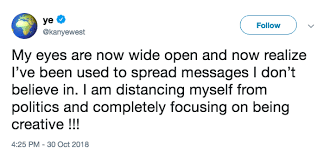
One of the things that seems clearest to me in Kanye’s case is that these public cycles have a pattern. We all witness the ramping up, the climax, and then the collapse, hospitalisation, and finally the aftermath: some form of apology, remorse, and amends making. Again and again we see the same arc: escalation, wreckage, fallout, reckoning. I’m not saying it erases the harm in any way, but I think it’s worth looking at.
Because if someone repeatedly returns from the other side of these episodes horrified by what they said and did, then at the very least we are looking at a pattern that should force more seriousness from us than the usual public performance of disgust. There is recurrent proof that he does not stably stand by the hateful things he says while spiralling. When he is in those manic states, it’s painfully visible, the cadence, the speed, the tone, the grandiosity, the certainty, the dissociation from reality.
Over the years, he has talked extensively about his mental illness and about struggling to find treatment that actually works for him (for example in a 2019 episode of My Next Guest Needs No Introduction with David Letterman; you can find it on Netflix). He has spoken publicly about how hard it was to find and accept help, how mania feels, how difficult it is to find the right medication, how quickly illness can become identity, and how humiliating it is to be watched while coming apart.
“I lost touch with reality. Things got worse the longer I ignored the problem. I said and did things I deeply regret. Some of the people I love the most, I treated the worst. You endured fear, confusion, humiliation, and the exhaustion of trying to love someone who was, at times, unrecognizable. Looking back, I became detached from my true self.”
You can decide it is all a lie, all theatre, all self-serving myth making. But if you do, then I want to ask a very basic question: what exactly does he gain from telling and living that story? What is the payoff in purposefully hurting so many people, alienating yourself, and then making amends, over and over again?
I would add that in my opinion, being constantly publicly scrutinised and being this rich are not exactly conditions conducive to sanity, and probably add gasoline to the mental health fire. One of the worst things that can happen to the human psyche is isolation, and extreme wealth is a particularly total form of it, because at a certain point you no longer belong to ordinary human life, and with that goes your sense of mutuality, proportion, and reality. I hate billionaires as much as the next person, but it doesn’t stop me from acknowledging that it is a psychologically agonising form of existence for the person themselves too. (On that topic, I recommend listening to the Bobo’s Void episode called The Absolute Horrors of Being Rich)
And maybe the cruelest part is the return. The part where the episode ends, the hospitalisation happens, the dust settles, and the person has to wake up inside the ruins. The part where you are once again lucid enough to see what you have done, who you have frightened, what you have destroyed, and the fact that none of your illness, however real, has magically removed the consequences. That, too, is part of the tragedy.
“I regret and am deeply mortified by my actions in that state, and am committed to accountability, truthful change, and meaningful change. It does not excuse what I did, though.”
And I think part of what makes this whole thing so painful to watch is that beneath all the noise, beneath the rage and the memes and the righteous posturing and the fan delusion, what I mostly feel is grief. Grief for a person who seems profoundly isolated and increasingly unreachable, grief for the people he has harmed, grief for the fact that we seem incapable of responding to any of this without immediately turning into executioners.
Grief, too, because I find it hard to imagine a scenario in which someone like Kanye ever gets his village back, ever gets surrounded by grounded people who care more about community, nourishment, truth, mutual aid, and actual love than they do about proximity to fame, money, chaos, and power. Fame seems perfectly designed to make healing impossible.
Is revenge justice?
When people ask me what I think about Kanye, what they usually want is for me to perform the correct ritual denunciation, to say he is over, finished, cancelled, dead to me. But I don’t believe cancellation is a serious ethical framework. I think it’s mostly a theatre of purification for people who want the pleasure of judgment without the burden of transformation.
We have a tendency to make systemic issues unique, because it’s easy. Kanye is a very convenient person in our lives, because as long as he exists, we don’t have to change anything. Sure, we might have done or said bad things, but at least we didn’t wear a swastika necklace or say slavery was a choice while half the planet was watching.
He becomes a kind of moral outsourcing mechanism, a grotesque public figure onto whom we can project all our certainty, all our revulsion, all our urges to dodge responsibility; and in the process we avoid asking harder questions about the systems that shaped him, the systems that continue to structure and enable so much violence against marginalised and oppressed people.
Cancel culture is moral prison for celebrities, and I’m a prison abolitionist. That means that on a very deep level I do not believe isolation, alienation, punishment and revenge can ever lead to justice. I do not think exile heals people, I do not think disappearance heals communities. I do not think silencing, shaming, banishing, and publicly enjoying someone’s destruction is evidence of moral superiority. In fact, I think the exact opposite. I think it is what people do when they have no real theory of harm, no real theory of healing, no real theory of accountability, and no tolerance for discomfort. (On that topic, I recommend reading Are Prisons Obsolete by Angela Davis, and We Will Not Cancel Us: And Other Dreams of Transformative Justice by Adrienne Maree Brown)
This does not mean I think everything should be tolerated, or that all forms of behaviour deserve platforms, audiences, or cultural power. In fact one of the things that seems most clear to me in Kanye’s case is that when he is visibly in the middle of an episode, giving him a microphone is profoundly irresponsible. People who platform a mentally unwell man while he is spiralling into hate speech because they know it will generate clicks, outrage, money, and engagement are guilty as fuck.
Exploitation is the opposite of accountability, and so is condemnation. Pointing fingers and saying someone is monstrous does not tell me what world you are trying to build. Refusing to stream an album does not tell me whether you have any coherent politics of repair.
We should explore what ethical seriousness would actually require from us in such situations. Not permissiveness, not denial, not pretending harm did not occur. It would require us working on a real theory of repair. It would require asking what accountability looks like when the person who caused harm is also: talented, famous, loved, and also not reducible to the worst thing they have done. It would require structures that can hold contradiction without immediately converting it into spectacle or exile.
This question is not just about celebrities, it’s about all of us. How do we live with the fact that the people in our lives will fail, wound, frighten, disappoint, betray, and still remain part of our moral universe? How do we respond when someone causes harm and is also in pain? How do we stay in community without becoming enablers, and how do we hold boundaries without turning into executioners? How do we repair harm when punishment is the only language we have been taught?
What I really wish for is a deeper conversation about what justice actually is once we stop confusing it with vengeance. bell hooks said, “For me, forgiveness and compassion are always linked: how do we hold people accountable for wrongdoing and yet at the same time remain in touch with their humanity enough to believe in their capacity to be transformed?”.
If we’re intellectually honest enough, and if we’re emotionally brave enough, the Kanye question is a human question.
Mental health is a group project
I grew up around mental illness that was not cute, not poetic, not easily transformed into an Instagram post about resilience. My father was bipolar and unmedicated, and there were substance abuse issues in the mix too, which meant that from very early on I had to learn to hold two things at once, namely the pain of being affected by someone’s mental and emotional instability, and the fact that I loved him anyway. (This is probably where you start wondering if my relationship to Kanye is simply a “daddy issues” type of thing - I guess we’ll never know).
There was no moral purity available to me in that situation, there was no clean side to stand on. All I had was proximity, confusion, anger, grief, love, fear, and the constant obligation to keep reality large enough to contain all of it.
His brother, my uncle, was diagnosed with schizophrenia when I was a child, and has said and done many terrible things. My family’s response, broadly speaking, was to want him to disappear. As far as I know, no proper conversations were had with him, about him, or among the people who loved him. His own mother pretended he stopped existing, and to this day, I’m met with silence and embarrassment when I try to talk about him. There was no village, no collective reckoning, no attempt to metabolise what was happening in a way that preserved his dignity. We avoided him, we felt shame, and he’s been institutionalised for many years now. We disappeared him. It devastated me as a child and it devastates me now, not only because of what happened to him, but because of what it revealed about the rest of us. We failed him, and by failing him we also failed ourselves.
One of the most important things I have ever heard on this topic came from Bobo’s Void, who said “there is no such thing as individual mental health.” I think about it all the time. We go to our individual therapy sessions to fix what we see as individual problems, but I believe we would benefit greatly from understanding that most of our issues are systemic more than personal.
We live in a world that mass-produces alienation, monetises narcissism and instability, isolates the suffering, glorifies domination, money and power, and then acts scandalised when someone breaks in public in a way that mirrors all of those logics back to us.
And guess what happens when you alienate someone: they go find belonging somewhere else, because belonging is a fundamental human need, and if healthy forms of community are absent, hateful ones are more than ready to step in. Research on radicalisation has found that extremist groups often draw people in by offering social bonds, love, acceptance, purpose, and a self reinforcing sense of community, while stigmatisation, punitive responses, and indignant public discourse can push at risk people further down the extremist path rather than interrupt it. (You can read this RAND report about it if you’re interested). Kanye is far from the only person in recent years to become an easy target for anti women or neo nazi rhetoric.
(Just to use another example to illustrate this point: I find the idea of mocking and publicly humiliating incels to be both unnecessarily sadistic and counterproductive, if we want to build a society that is safer for everyone.)
But still, despite my general exasperation with the way we talk to and about people who are both suffering and causing suffering, I don’t want to give up on the idea that we have the intellectual, emotional and practical resources to build something better than this; maybe not for Kanye, maybe not in time for Kanye, but for ourselves, for each other, for the people in our actual lives.
We need to talk about what accountability and repair look like outside the framework of cancel culture and prison. We need to talk about how we remain in community once harm happens. We need to see healthy community as a shared responsibility.
Maybe we should also talk about how moral perfection doesn’t exist for anyone, how we have all been, throughout our lives both abusers and victims (even if in small ways), because we are human. How we were lucky that the spotlight wasn’t on us when that happened.
We have to be able and willing to tell the truth, to hear the truth, and to stay with the truth.
Kanye is not interesting because he forces us to choose between art and artist. He is interesting because he exposes how little moral, political, and communal language we have for responding to a person who is at once gifted, harmful, unwell, powerful, exploited, and as much as we hate to face it, part of our human community.
We need to become people who can survive complexity, because if we cannot do that, then the only tools we are left with is punishment and self-congratulation; which is to say the exact same tools that keep producing and enabling the exact same harm.
And if that is the best we can do, then I really don’t think we get to wish for a healthy society.
I loved reading this. It really points to the truth of the matter, that the real problem lays within a sick society and how we view justice.
I love your reflections on this very complex topic and I appreciate the realness and the acknowledgement of ambivalence in such cases like Kanye’s. Our culture holds such a strong desire outcalling, cancelling and even demonize individuals because its so much easier than to actually look into the structures which lie beyond all those individuals which in return reproduce and express the deeper violence at work.
Thank you Alice!!